ACT Math Fundamentals and the 'Missing Middle'
23 Oct 2026
Today we launched ACT Math Fundamentals on Math Academy - a 905-topic course covering the entire mathematical scope of the ACT exam, including 88 new “missing middle” topics built specifically for the test.
The Gap Between School Math and Exam Math
One thing that has long concerned me about math education is the size of the gap between what is taught in a standard school curriculum and what is actually tested on standardized exams like the ACT and SAT.
Most students and parents assume that if a student earns A’s in Algebra, Geometry, and Precalculus, they have been taught the math on the exam.
Often, they haven’t.
Between standard textbook exercises and the problems that appear on standardized exams sits a large “missing middle”: problems where familiar concepts are combined in non-standard ways, disguised in unfamiliar representations, or constrained so that standard textbook procedures fail.
For example, a student who can solve two-variable linear systems by substitution may still freeze when given a single homogeneous equation like
\[\frac{3x - y}{x + y} = \frac{5}{8}\]and asked for the ratio $\frac{x}{y}$ directly. A student who knows the formula for the volume of a cube may stall when given only the outer perimeter of its unfolded 2D net, or the top, front, and right-side grid views of a stack of unit cubes. And a student who can compute the mean, median, and range of a list of numbers may be unsure how those statistics move when no numbers are given at all - only a constraint on how the minimum value changes.
Why Pacing Collapses Without Explicit Instruction
In theory, a conscientious student who knows the fundamentals could figure many of these problems out given 15 minutes of quiet thought on a homework assignment.
On the ACT, however, the entire Math section runs on a single tight clock - roughly a minute per question on average. Because the questions are ordered roughly by difficulty, spending three or four minutes trying to invent a method on a handful of unfamiliar problems in the middle of the section drains the clock, causing students to run out of time before they even reach the final stretch of the exam.
At that point, the test is no longer measuring how well a student learned their school coursework. It is measuring working-memory capacity and on-the-fly generalization under time pressure.
Step one of serious test preparation is making sure you never have to invent those methods on the spot.
How ACT Math Fundamentals Works
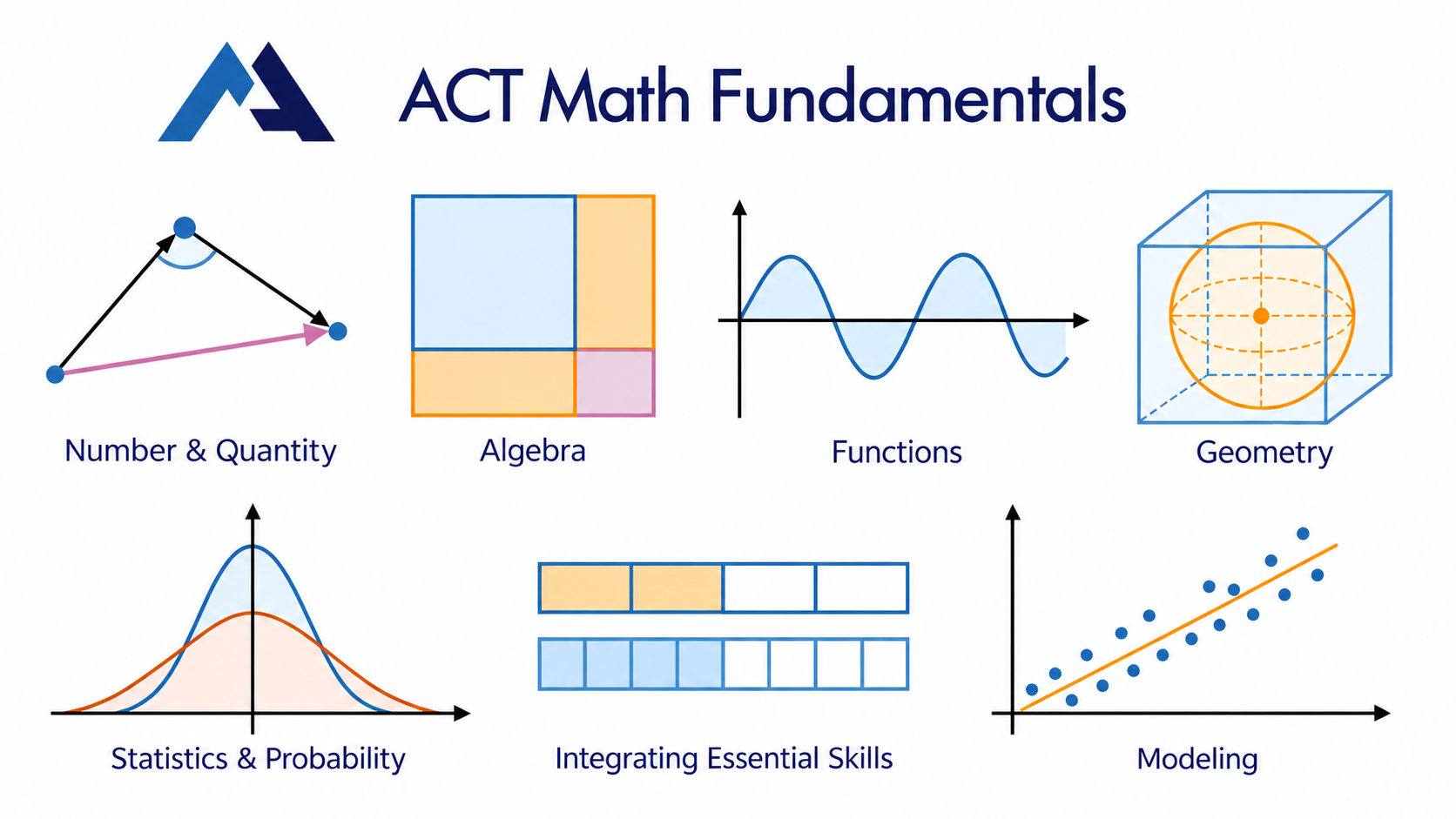
Our new ACT Math Fundamentals course spans the full breadth of the exam across seven core domains:
- Number & Quantity: Exponents, scientific notation, radicals, number theory, conditional logic, complex numbers, vectors in 2D and 3D, and matrices.
- Algebra: Linear equations and systems, inequalities, absolute value constraints, polynomials, quadratics, exponential equations, and rational and radical equations.
- Functions: Function composition and inverses, transformations, quadratic and polynomial graphs, logarithms, rational functions and slant asymptotes, sequences and series, parametric equations, polar coordinates, and full trigonometry (the unit circle, trig graphs, identities, double-angle and sum/difference formulas, and inverse trig functions).
- Geometry: Angles, transformations, triangles, polygons, 3D solids, congruence, similarity, composite and inscribed figures, coordinate geometry, circles, conic sections (ellipses and hyperbolas), and general triangle trigonometry.
- Statistics & Probability: Sampling, frequency tables, data displays, comparing distributions, correlation and regression, probability, compound and conditional events, combinatorics, discrete random variables, and the normal distribution.
- Integrating Essential Skills: Multi-stage ratios, unit rates, direct and inverse variation, successive percentages, and compound unit conversions.
- Modeling: Constructing and interpreting linear, inequality, and quadratic models in context.
Throughout all seven units, we have woven in over 150 “missing middle” topics (66 shared with our SAT curriculum and 88 excavated specifically from the ACT distribution), breaking each one down into explicit, scaffolded knowledge points.
Stage 1 (Fundamentals) vs. Stage 2 (Prep)
Students begin ACT Math Fundamentals with an adaptive diagnostic assessment that identifies their exact knowledge frontier across all 905 topics. Our algorithms then construct a personalized learning path that repairs any upstream prerequisite weaknesses first and systematically builds fluency across every problem structure the exam tests. Lessons are untimed (with periodic timed quizzes to verify retention) so students can build deep structural understanding without rushing.
Once students complete Fundamentals, they will be ready to promote into ACT Math Prep (launching soon) - a dedicated exam-conditioning training ground with no new instruction, focused purely on high-fidelity ACT-style practice exams and mastering the strict timing of the actual test.
If you want to build a rock-solid foundation for the ACT, you can explore ACT Math Fundamentals on Math Academy.